In Inability for Teenage Girls to Express Interests Online
Written by Ireland Fidale, a WSTB05 student from the University of Toronto
This essay was submitted as part of OPF's partnership with the WSTB05 class (Understanding Power and Knowledge in Research). More information about our partnership can be found here.
In the digital age, we have been given the opportunity to connect with people all around the world. Discover new things, meet people with similar interests, and expand our knowledge on anything we can imagine. Despite the advancement society has made with social media, there has been a continuation of deep rooted misogyny that has come along with it. I chose to focus on the issue of teenage girls being unable to express their interests on social media. According to an Online Harassment report from Pew Research Center, women have an 11% higher rate of being a target of harassment due to gender online, while men have a 5% chance. (Pamungkas et al. 2) As someone who is involved in specific interest communities on social media, I have seen time and time again the way teenage girls are targeted just simply for enjoying something. “Jane (2018) believes that gendered abuse and threats online cause “embodied” rather than “virtual” harm and that the behaviors present in virtual interactions can map onto more familiar forms of offline violence against women and girls.” (Kavanagh et al. 552) Research shows that there is a clear issue with the way women are treated on social media, and it can then fester into something larger, putting women in dangerous situations that can harm them and those around them. My goal with my creative piece was to visually portray how it feels to be targeted by misogyny on the basis that I have expressed my interest in something that many other people like as well.
It was not difficult to find research discussing the issue of how women are treated on social media. Misogyny is a long withstanding issue that social media has given a platform to accentuate the reality of the issue.
Respectability politics is grounded in a set of standards that prescribe piousness, temperance, decorum and self-restraint, sexual restraint, propriety and morality, neat appearance and self-protection. It requires public display of these standards by the person and is used to determine those worthy or unworthy of respect, as Rowe (2013) discusses, respectable status is precarious and requires constant policing of self. (Barratt 17)
I used this assignment as an opportunity to express my own feelings through the creative piece. I have personally experienced issues with portraying what I enjoy online as a woman, and wanted to showcase what it feels like. I depicted myself in this piece, using interests I have, and have been judged for on the internet. To have someone harass you for something that brings you joy can affect the way you feel about the things that make you happy, and expressing that happiness to others. Explaining the feelings that go along with being ridiculed by people you do not know because you enjoy something can be hard for those who do not experience it to understand, so I wanted to create something for people to see how it feels. My piece engages with the sources I have used as I took the ideas of verbal harassment and aggressive language used towards women online, and incorporated it into my piece. The course concepts being applied are ideology and the critical paradigm. In terms of my creative piece, both concepts relate to each other, in that it is showcasing an inequality in the way women are treated, and the misogynist ideologies behind it. My creative method says something about my topic that is otherwise hard to communicate by showcasing the defeat that comes along with it. There is not anything women can do to change how they are treated online, because there is no helping to protect us.
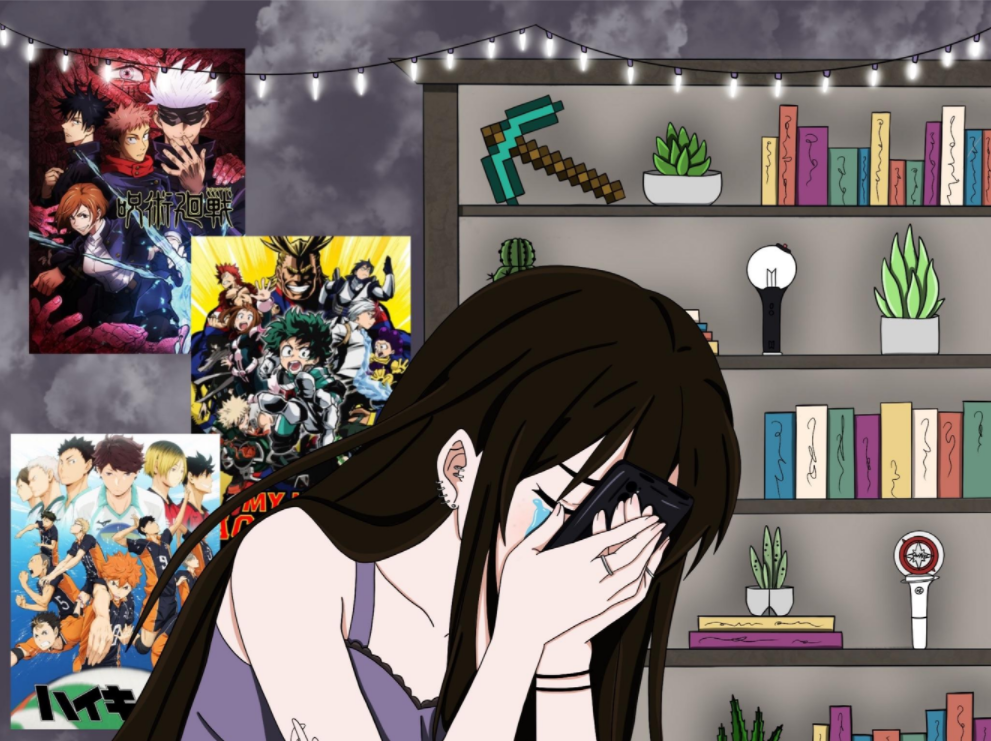
In the current society where social media has made it easy for people to connect and comment, women have had to face more harassment and hate due to the misogynistic mindset many still live in, and now have a platform to express. Teenage girls are not able to enjoy anything without facing backlash just for simply expressing their interests. From something as simple as makeup or music, women cannot express happiness or interest, because men have the ability to veto it all with the simple click of a button. Forms of harassment and abuse to women online can even then transfer into violent situations against them in real life, due to this expression against what they like. Using a creative method to display an ideological issue can be a powerful way to showcase the deeper feelings and emotions people feel when being faced with an issue like this. It creates an opportunity for people to express themselves without using words, and still being able to display an issue that needs to be acknowledged.
Works Cited
Barratt, Sue Ann. “Reinforcing Sexism and Misogyny: Social Media, Symbolic Violence and the
Construction of Femininity-as-Fail.” Journal of International Women’s Studies, vol. 19,
no. 3, Bridgewater State College, 2018, pp. 16–31.
Kavanagh, Emma, et al. “Sporting Women and Social Media: Sexualization, Misogyny, and
Gender-Based Violence in Online Spaces.” International Journal of Sport
Communication, vol. 12, no. 4, 2019, pp. 552–75, https://doi.org/10.1123/ijsc.2019-0079.
Pamungkas, Endang Wahyu, et al. “Misogyny Detection in Twitter: a Multilingual and
Cross-Domain Study.” Information Processing & Management, vol. 57, no. 6, Elsevier
Ltd, 2020, p. 102360–, https://doi.org/10.1016/j.ipm.2020.102360.