Category Archives: GIH Week Summaries

A Summary of “IMF, World Bank and COVID-19 Relief – A Modern-Day Trojan Horse?”

by Alec Wills

          The COVID-19 pandemic has thrust the world into a state of extreme uncertainty and grave socioeconomic instability. The damage has been twofold: a severe public health crisis combined with a massive contraction of the global economy. As a result, many countries have been put into a severely stressed economic position¹. Large amounts of resources are needed to craft and enforce appropriate policies, such as providing additional funding for the healthcare sector, financial relief for the unemployed and/or struggling, and vaccination procurement. The lack of wealth and resources in lower income countries might make these tasks immensely challenging. Enter the International Financial Institutions (IFIs)–specifically, the International Monetary Fund (IMF) and World Bank–whose roles are to provide loans to countries in crises and/or precarious economic positions, loans with conditionalities which the receiving government must comply with. What are the benefits and drawbacks of these transactions? Are the IFIs the saviour of the Global South? Or are their actions a Trojan Horse: a tactical maneuver designed to undermine and conquer disguised as a gift. This was the topic discussed in the “IMF/World Bank: A Modern Day Trojan Horse?” seminar for UTSC’s Global and International Health Week. Below, I offer a reflection on this presentation.

Continue reading A Summary of “IMF, World Bank and COVID-19 Relief – A Modern-Day Trojan Horse?”
A Summary of “Fact or Fiction? Myth-busting COVID-19 Conspiracy Theories”

by Alec Wills 

          Conspiratorial thought is a recurring phenomenon in Western society. From the assassination of John F. Kennedy to the 9/11 terrorist attacks, conspiracy theories seem to inevitably find large and receptive audiences¹. In the recent past, their relegation to niche recesses of YouTube and/or obscure documentary films made them a somewhat benign occurrence, but the narratives emerging around the COVID-19 pandemic have significant implications for public health and the future of the world².  This comes at a time when social media makes it easier to spread misinformation³, while conspiracy theorists are elevated to the highest echelons of institutional power, notably the former president of the United States Donald Trump. These elements, combined with a society that has seemingly no shortage of cynical and distrustful people, provide an ideal petri dish for outlandish claims regarding the COVID-19 pandemic. UTSC’s Global & International Health Week’s “Fact or Fiction? Myth-Busting COVID-19 Conspiracy Theories” seminar analyzed and critiqued these theories and challenged their presuppositions. Below, I offer a reflection on this presentation and the topics discussed.

           The presentation began by differentiating misinformation from disinformation. The former refers to incorrect or misleading information not necessarily disseminated for deceptive purposes. The latter uses misinformation in the forms of hoaxes and propaganda for the specific purpose of misleading and instilling fear in part of the population. Following these introductory definitions, five COVID-19 conspiracy theories were presented:

  1. Personal protective masks are unnecessary, harmful, a violation of human rights, and/or emasculating. 
  2. COVID-19 is being used for population control by killing off the elderly. 
  3. Bill Gates is microchipping the population through vaccinations.
  4. COVID-19 is an orchestrated pandemic by some nefarious organizations (i.e. The New World Order, the Illuminati, etc.).
  5. COVID-19 was created in a laboratory and is being used as a biological weapon.

Continue reading A Summary of “Fact or Fiction? Myth-busting COVID-19 Conspiracy Theories”

A Summary of “Bill & Melinda Gates Foundation* – Global Saviour or Guardian of Corporate Interests?”

by Alec Wills 

   For almost two decades, The Bill & Melinda Gates Foundation has played an influential role in international politics. It has funded vaccine research and distribution; pledged to help achieve both the Millennium Development Goals and Sustainable Development Goals; invested in fighting Malaria, AIDS, and tuberculosis; funded the Alliance for a Green Revolution in Africa, which seeks to improve the livelihoods of smallholder farmers; and most recently provided funding for research and production of the COVID-19 vaccine; among many other initiatives. During UTSC’s Global International Health Week, the “Gates Foundation: Global Saviour or Guardian of Corporate Interests?” presentation critically analyzed the foundation and discussed the broader implications of the billionaire’s influence in the world.

Continue reading A Summary of “Bill & Melinda Gates Foundation* – Global Saviour or Guardian of Corporate Interests?”

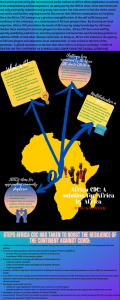
A Summary of “Africa CDC: A Solution for Africa by Africa”

by Anastasia Kasirye

Diagram

Narratives produced by international media outlets on Africa often emphasize on notions of its codependency and incompetence. As aptly put by the IDSC11 class, these narratives are not only extremely reductive and grossly inaccurate, but also serve to fuel the white savior narrative and further ongoing harmful discourses that African communities are helpless. Here the Africa CDC emerges as a glorious exemplification of the self-sufficiency and resilience of the continent, as a valorization of African perspectives.  By drawing on local expertise, Africa CDC prioritizes the needs of Africans by using knowledge for Africans.  Rather than waiting for external players to take action,  Africa CDC has acted swiftly, quickly mobilizing task forces, securing equipment and materials and developing policies to address COVID-19 and other disease outbreaks. In doing so, Africa CDC enhances the agency of African players and empowers local communities  to take action in the face of the pandemic. A global testament to the fact that what Africa is doing is working?  COVID-19 DEATHS ON THE CONTINENT AS A WHOLE ARE LOWER THAN THE GLOBAL AVERAGE.

MULTILATERALISM IN AFRICA:

The continent has pursued a multilateral approach in handling COVID-19. The Africa  Task Force for the Novel Coronavirus has supported a pan-African approach in compiling, analyzing and sharing information.

Continue reading A Summary of “Africa CDC: A Solution for Africa by Africa”

A Summary of “Trust & Health Inequities” with Mandekh Hussein

by Jerusha Alvares 

On March 9, UTSC had the pleasure of virtually hosting one of its alumni as part of Global & International Health Week. Mandekh Hussein, a graduate from the Centre for Critical Development who currently works as a primary care workforce strategy consultant and a lecturer at Brunel University spoke on the topic of “Trust and Health Inequities in Primary Care”. The event attracted attendees from across North America and the United Kingdom.

The presentation began by examining the sources of health inequities and the barriers to accessing primary care which enable such inequalities to persist. These included insufficient time with health professionals during appointments, language and cultural barriers, isolation caused by a lack of access to the technology necessary for digital consultations and the lack of a permanent address or immigration status that are required when completing the paperwork required for appointments.

Hussein also spoke about how practitioners learn about health inequalities early in their career, but struggle to implement these ideas into reality. She continued on by suggesting ways to overcome these barriers. These included cultivating spaces for communities to engage in conversations with practitioners in a safe space for them to voice their concerns, using various tools and platforms to engage participants, and running workshops in local languages to dissipate misinformation. As an example, Hussein discussed her own work with the Somali community in England and how such conversations that took place in their own language allowed them to raise concerns and answer each other’s questions on pressing topics such as childhood immunization.

Continue reading A Summary of “Trust & Health Inequities” with Mandekh Hussein

Unprecedented Times: a Poem On the “Untold Stories of Civil Society – Unifying Communities Across the Globe”

by Kibati Femi-Johnson 

Civil society is the third aspect of our communities; the other two being businesses and the government. There is often much talk about the other two sectors, understandably, but there is not as much public acknowledgement of civil society. These “untold stories” highlight the impact that we, as citizens, can have on one another. Most recently, as of 2020-2021, the pandemic gives us an opportunity to shift our focus from global-scale intervention, and ask ourselves how we can intervene in the lives of those immediately around us. This poem represents the personal experiences of someone’s neighbour, cousin or school teacher. Although not intended to be specific to any individual person, it is somehow relatable to us all; thereby reinforcing the notion that we are more similar than we may recognize. The poem aims to remind us that our relationships, which we would normally engage in on a daily basis, can persist even in these “unprecedented times”, and in fact, be strengthened by them. As the poem details the problems that so many around the world are currently facing, the very end provides a breath of fresh air: reminding us that we are responsible for the change we want to see in our own communities.

Unprecedented Times 

Abrupt.

Sudden.

Disruptive in every way.

Continue reading Unprecedented Times: a Poem On the “Untold Stories of Civil Society – Unifying Communities Across the Globe”